
1
Opportunity
- Identify & understand
- Qualify needs & wants
- Get parts/models
- Confirm timeline
- Expectation alignment
Travis Fey, General Manager & Engineering Manager
SUMMARY
Packaging material cost is easy to see on a quote. The larger costs, freight, damage, handling, and disposal, sit in the operation, where they repeat on every shipment for the life of a program. This paper explains the economics of returnable packaging on total cost of ownership rather than unit price. It shows why truckload density is the lever that sets freight cost, how returnable systems differ from expendable ones as an investment rather than a purchase, the five operational value drivers a well-engineered returnable program delivers, and a practical framework for when returnable pays and when expendable is the right answer. The short version of that framework: returnable generally makes sense at annual part volumes around 10,000 and above, with predictable schedules and higher-value or cosmetically sensitive parts, and it typically reaches break-even in one to three years, driven by part value, packaging cost, freight, and damage.
WHY IT MATTERS
Freight is the hidden cost because it is paid by the trip, not by the part, so it never appears on the packaging quote yet dominates the lifetime spend. Every part that does not fit on a truck raises the cost of moving all the others, shipment after shipment, for the entire life of the program. A packaging decision made on unit price alone optimizes the smallest number in the equation and ignores the largest.
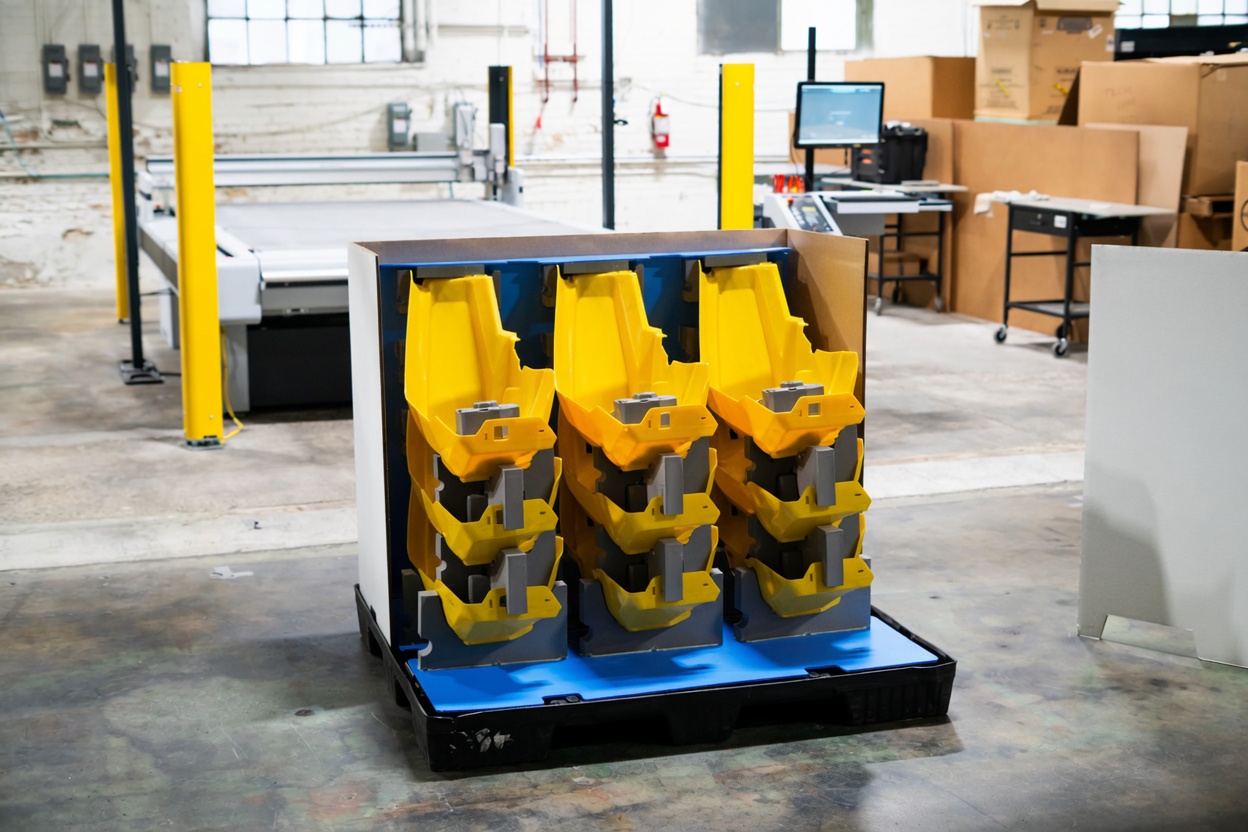
The lever that sets freight is truckload density, and density is set by the container’s usable interior space. A pack engineered to the part captures interior space, in both the footprint and the height of the trailer, that a stock container wastes.

Returnable packaging is a specialized discipline, and PSi’s expertise in it was built on the floor across more than three decades. The returnable model is the large majority of what PSi engineers, which is why the economics below come from repeated real programs rather than theory.
HOW IT WORKS
Density reduces freight by fitting more parts in the same trailer, which cuts the number of trucks. When a container is engineered to the part rather than adapted from stock, it recovers wasted interior space and raises the parts per truck. Fewer trucks means lower freight on every shipment, and because a returnable pack runs for years, that saving compounds across the whole program life.
This is not a marginal effect. In documented programs, engineering the container to the part has raised parts per truck substantially and cut ongoing freight by meaningful double-digit percentages, with the largest gains reaching around 60 percent.
THE COMPARISON
The real difference is that expendable packaging is a repeated purchase and returnable packaging is an investment recovered over many cycles. Expendable is bought and discarded, so it competes on unit price and a cheaper option is always an open door. Returnable costs more up front and earns that cost back across many trips through lower freight, less damage, better handling, and less waste. The right comparison is never the two unit prices. It is the total cost of ownership of each approach over the program’s life.
Because returnable is an investment rather than a purchase, adopting it is a decision that has to be justified on a return, not an order placed on price. That is why the framework below matters.
THE VALUE DRIVERS
A well-engineered returnable program creates value on five operational fronts at once, and only one of them, the purchase price, shows up on the quote. In PSi’s framing, returnable packaging exists to protect the product and reduce damage, improve ergonomics for the people handling it, improve assembly-line efficiency by presenting parts ready to use, reduce freight through better density, and reduce waste and handling. The other four live in the operation, which is where the larger money sits.
THE DECISION GUIDE
Returnable pays off when volume is high and predictable and the part is valuable or sensitive enough to justify the investment. As a working guide, returnable generally makes sense at annual part volumes around 10,000 and above, with predictable production schedules, defined supplier-to-plant lanes, and higher-value or cosmetically sensitive parts. For low-volume runs or one-time shipments, a well-designed expendable solution is usually the better answer.
Most customers justify a returnable program on a break-even window of one to three years, and when budgets are tight they look for one year. The payback is driven by four variables:
Decision guide
| Signal | Points toward returnable | Points toward expendable |
| Annual volume | Around 10,000 and above | Low or intermittent |
| Schedule | Predictable, defined lanes | One-time or unpredictable |
| Part value and sensitivity | High value or cosmetic | Low value, tolerant |
| Break-even horizon | One to three years acceptable | No horizon to recover on |
THE BUSINESS CASE
You build it on total cost of ownership, not unit price. A credible returnable case counts the packaging cost, the freight, the damage avoided, and the disposal and sustainability costs that expendable packaging keeps generating. Put against that full picture, a returnable system that costs more per unit routinely costs far less per year. The variables that carry the model are the value of the part, the packaging cost, the freight cost, and the damage prevented, evaluated across the program’s service life rather than a single shipment.
SUSTAINABILITY
Yes, and the honest version of that story is about reuse, not recyclability. A returnable system engineered to run for years of cycles, often five to seven years or more, keeps far more material out of the waste stream than a recyclable expendable used once. Fewer trucks also mean lower trucking emissions and carbon footprint. Recyclability is genuinely mixed, since some dunnage is recyclable and glued or laminated inserts are not, so the credible claim leads with lifecycle and reuse. This is what PSi means by engineering sustainable outcomes: the total-cost story and the environmental story are the same story.
HOW WE WORK
Returnable programs run through PSi’s six-step process: Opportunity, Engineer the Solution, Validate, Quote, Order Confirmation, and Order Fulfillment. The density study during the Engineer step is where the freight and cost case is first quantified, before design is committed.
The returnable-versus-expendable decision is a total-cost decision, and the costs that matter most are the ones a quote never shows. Engineering density into the pack lowers freight on every shipment, and reuse recovers the investment over years. As freight and sustainability pressures rise together, the total-cost case for well-engineered returnable systems only strengthens.
Not on unit price. Returnable costs more up front and becomes cheaper over its service life once freight, damage, handling, and waste are counted.
Generally at annual part volumes around 10,000 and above, with predictable schedules and higher-value or cosmetically sensitive parts. Break-even is typically one to three years.
The value of the part, the packaging cost, the freight cost, and the damage the packaging prevents, assessed on total cost of ownership including disposal and sustainability.
Freight is paid per trip, so a pack that fits more parts on a truck lowers the cost to move each part. Engineering the container to the part raises density and cuts the number of trucks.

About Us
Packaging Solutions, Inc. is a custom packaging engineering company founded in Milwaukee in 1994. For 32 years, PSI has engineered and built returnable packaging systems for manufacturers whose production cannot afford a packaging failure, with engineering and the manufacturing floor under one roof.
PSi’s senior packaging engineers hold four-year packaging degrees, while returnable packaging itself is a discipline taught nowhere academically and learned on the floor across decades.

It’s our name. It’s our business!
Packaging Solutions, Inc.
Milwaukee, Wisconsin
We respond within 1 business day.
© 1994–2026 Packaging Solutions, Inc.