Harry Moulopoulos Jr., Business Development
White paper
Automation-Ready Returnable Packaging: Engineering Parts for Robotic Assembly
SUMMARY
Executive summary
Automated and robotic assembly is reshaping what returnable packaging has to do. A robot does not adapt the way a person does. It places and removes a part only if that part sits in a consistent position and orientation every cycle, which makes the packaging part of the automation system rather than a container around it. This paper details how PSi engineered a returnable sleeve pack that a robotic cell could load automatically for a complex fluid-carrying assembly in the EV and automotive space. It covers why a collapsible sleeve pack was chosen over a rack and a bulk bin, how the dunnage was engineered to a robotic gripper and a machine-vision system, why the material had to change from cross-linked foam to molded expanded polypropylene to hold automation-grade tolerances, how molded locating features let a 3D camera find each part, and how the same dunnage was designed to serve both an automated loader at the supplier and a human operator at the assembly line. The differentiator is delivering automation-ready parts presentation in a returnable sleeve pack that costs a fraction of the rack the market defaults to, while using the trailer far more efficiently.
WHY IT MATTERS
Why does automation change what returnable packaging has to do?
Automation changes the job of packaging because automation runs on parts presentation. A robotic cell wants each part loaded and unloaded consistently, meaning in the same position and orientation every single time. A human picking from a bin adjusts to a part lying any which way. A robot cannot. If the part is not where the machine expects it, the cell fails.
This reframes the pack. It is no longer a box that protects a part in transit. It is the fixture that presents the part to the machine. Done well, it removes a step that automated lines often cannot avoid: taking a part out of shipping packaging, repacking it into a dedicated fixture, and only then feeding it to the line. A pack engineered for presentation lets the automation work straight from the returnable container.

Industry context
Automotive has long been one of the most heavily automated manufacturing sectors, and the shift toward EV production is accelerating investment in robotic assembly. Tier-one suppliers increasingly load parts for downstream OEM lines with automation, which places new demands on the packaging that feeds those cells. When the line automates, the pack has to keep up.
WHAT IT IS
Why a sleeve pack over a rack or a bulk bin?
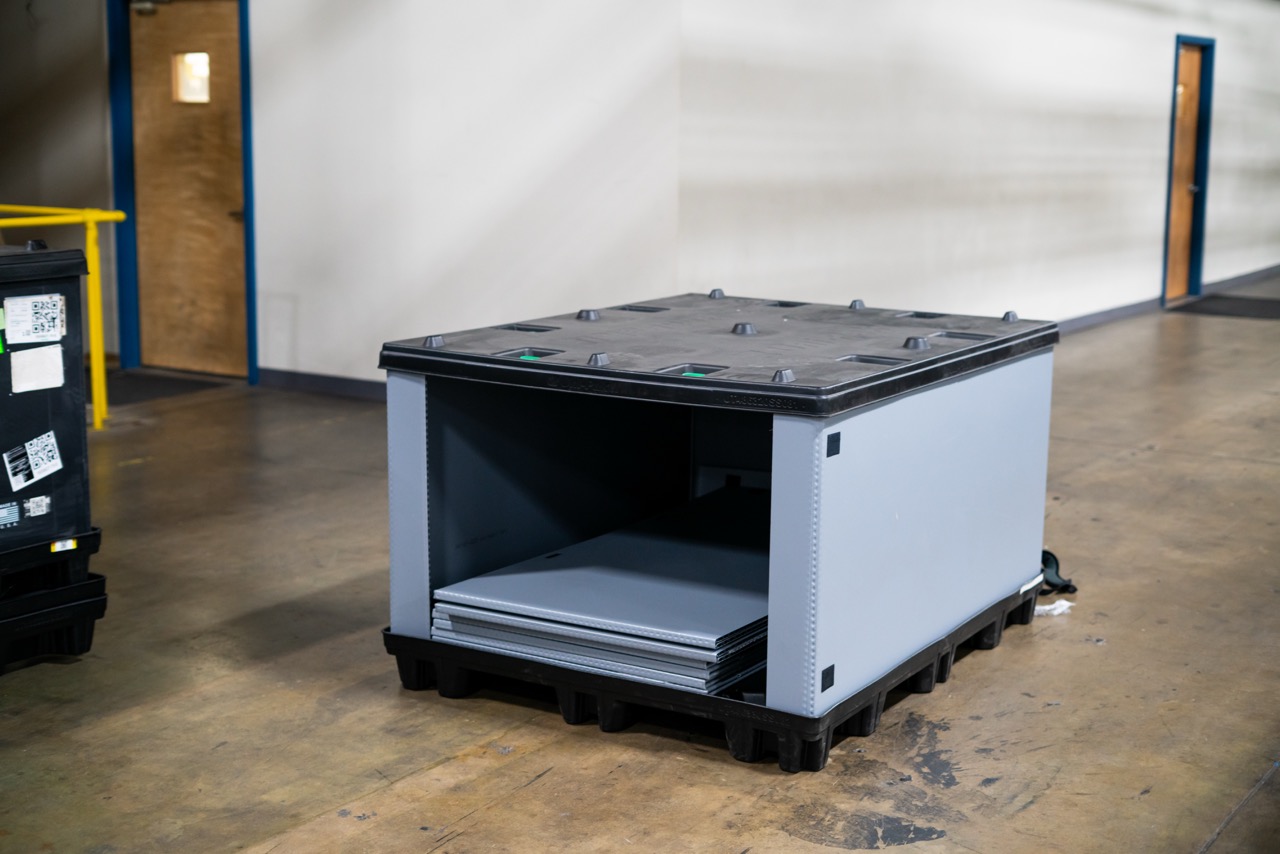
Three formats were compared: a rack, a bulk bin, and a collapsible sleeve pack. The evaluation weighed the factors that decide a returnable program: parts per container, part presentation, collapsibility for the empty return trip, how efficiently each fills a truck, and cost.
All three formats can present parts consistently, and all three can be engineered to feed automation, so neither of those was the deciding factor. The sleeve pack won on the factors that were: it met the parts-per-container target, collapsed efficiently for the return trip, used the trailer far better than a bulk bin or a partially filled rack, and cost a fraction of what an equivalent rack costs. A rack can run several times the price of a sleeve pack, which is the difference that decided the program.
Comparative view
| Criterion | Rack | Bulk bin | Collapsible sleeve pack |
| Parts per container | Same or less | Less | Met the target |
| Structured part presentation | Yes | Yes | Yes |
| Collapsibility for return | Medium | Medium | Strong |
| Truck efficiency | Medium | Low | High |
| Cost | Expensive | Medium, but more containers needed for loop size | Medium |
HOW IT WORKS
How do you engineer a pack a robot can load?
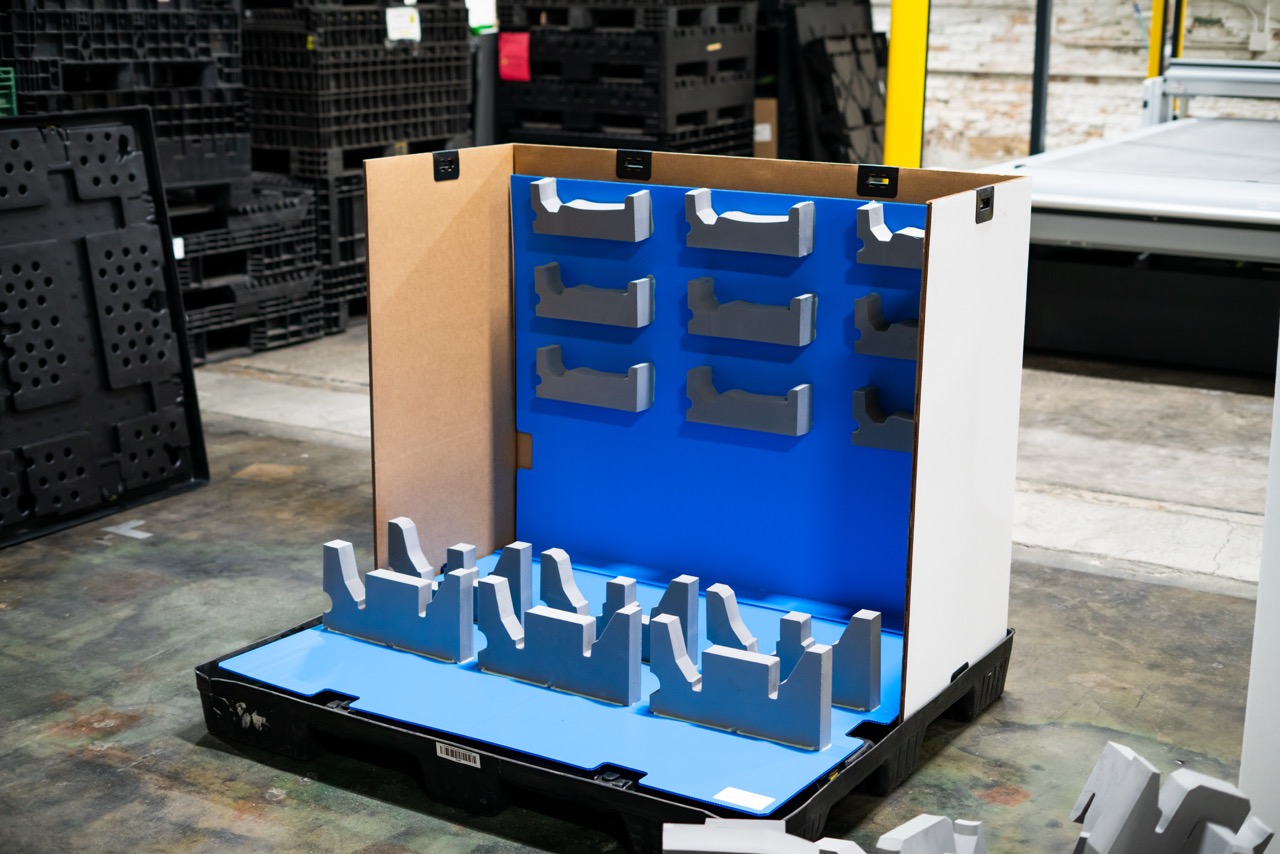
You engineer it to the automation, not just to the part. PSi was initially asked to design and engineer dunnage, then learned partway in that automation was being built to load the parts. The pack had to let a robotic gripper place each part precisely and repeatably.
The automation supplier provided the gripper CAD and loading requirements, and PSi designed the dunnage to that gripper and to how the cell locates a part. Two questions drove the work: what tolerances the automation needed, and how the vision system would find where to place each part.
Locating is the subtle problem. Parts do not settle in the same spot every time, so the machine needs fixed references. A 2D machine-vision view could not read the loading area reliably, so the program moved to a 3D camera, and PSi added high-contrast locating features into the dunnage for it to lock onto. That is what lets automation load a returnable pack repeatably.
THE MATERIAL
Why does material choice determine whether automation works?
Material determines whether the pack can hold automation-grade tolerances. The design began in cross-linked foam, a common protective material. The automation then called for tighter tolerances than cross-linked foam could hold, so the design moved to molded expanded polypropylene (EPP).
EPP does two things cross-linked foam could not. It holds tighter, more repeatable tolerances, which the robotic placement requires. And because it is molded, it can carry integrated locating features rather than relying on added parts. In this program it also came out more cost-effective. PSi sources molded EPP through a manufacturing partner. The lesson generalizes: when packaging has to feed a machine, material selection is a precision decision, not just a protection decision.
THE DESIGN
How do you serve the machine and the human at the same time?
You design the dunnage for two users with opposite needs. At the supplier, an automated gripper places parts into the pack, which demands precision and a repeatable datum. At the assembly line, a human operator removes each part by hand, which demands easy access and a clean release. A design that serves only the robot can trap the operator, and a design that serves only the operator can defeat the automation. The dunnage had to do both.
The part itself added constraints on top of that. Certain surfaces could not bear weight, others could not be touched at all, and the assembly had to hold a specific orientation, which the automation reinforced because the gripper places the part one way. Every one of those rules had to be honored in the same piece of dunnage.
SCOPE OF WORK
Who engineers what in a program like this?
This kind of program is an integration effort across several parties, and being honest about the boundaries matters. PSi engineered the pack and the dunnage. The customer and its automation supplier built the robotic cell and the gripper. PSi designed to the gripper’s CAD and requirements and brought in an outside vendor for automation-grade locating expertise. Several components, including the molded EPP, are partner-manufactured.
The accurate way to describe PSi’s role is engineering and integration lead: PSi solved the packaging and presentation problem and coordinated the parties, rather than manufacturing every component in the stack. For a buyer, that is the point. The value is the engineering that makes automated loading work, sourced and integrated correctly, not a claim to build every piece in-house.
WHO IT’S FOR
Where does this apply, and what does it enable?
The approach applies wherever automated assembly meets returnable packaging. The most natural fits are tier-one automotive suppliers, powersports and side-by-side manufacturers, and on-road and off-road vehicles including trucks, all of which are moving toward automated handling. Appliance manufacturers pursuing automation are a logical adjacency.
The enabling benefit is consistent parts presentation from a returnable, reusable pack that costs far less than a rack and fills a truck better. Automation wants every part perfectly positioned, and this approach delivers that without a separate repack-into-a-fixture step.
Implementation over a 12 to 36 month horizon: adoption follows the returnable model’s own logic. The pack is a capital investment recovered over many cycles, and an automation-ready pack recovers it two ways. It earns back like any returnable system, through reuse over years rather than repurchase, and it earns back again by removing a step the line would otherwise pay for on every part: taking the part out of shipping packaging, repacking it into a dedicated fixture, and only then feeding it to the cell. In this program the pack has already been adapted for an updated version of the part and reused for follow-on work, so the original engineering keeps paying back across product changes rather than being scrapped with each revision.
Conclusion and future outlook
Automation rewards consistency, and packaging is where consistency starts. Engineering a returnable sleeve pack that presents parts to a robotic cell, holds automation-grade tolerances in a molded material, gives a vision system features to lock onto, and still releases cleanly for a human operator, is a genuinely uncommon capability. The market tends to deliver automation-ready presentation with racks, which are expensive and bulky. Delivering the same presentation in a collapsible, truck-efficient returnable sleeve pack, at a fraction of the cost, is the differentiator.
The horizon: as more assembly lines automate across vehicle and adjacent manufacturing, packaging engineered for parts presentation moves from a niche request to a standard requirement. The pressure is compounding. Manufacturers want the labor and consistency benefits of automation and the cost and sustainability benefits of returnable systems at the same time, and historically those two goals pulled against each other, because automation leaned on rigid racks while returnable economics favored collapsible packs. Engineering presentation-grade repeatability into a returnable pack is how both goals are met at once. PSI’s view is that this is where the category is heading, and that the suppliers who can engineer for the machine and the operator together, rather than only protect a part in transit, are the ones automated lines will standardize on.
Frequently asked questions
Can returnable packaging work with robotic assembly?
Yes. When the dunnage holds each part at a consistent position and orientation and gives the vision system features to locate, a robot can load and unload directly from a returnable pack.
Why use a sleeve pack instead of a rack for automation?
A sleeve pack can deliver the same repeatable part presentation as a rack while adding higher parts-per-container density, collapsibility for efficient returns, and significantly lower cost. A rack can run several times the price of a sleeve pack.
What makes packaging material suitable for automated loading?
The material has to hold tight, repeatable tolerances. Molded materials such as EPP hold tighter tolerances than cross-linked foam and can carry integrated locating features for machine vision.
How does a machine know where the part goes?
A 3D vision system reads high-contrast locating features built into the dunnage, which give it fixed references to place parts accurately even when parts do not sit identically each time.
ABOUT PSI
About Packaging Solutions, Inc.
Packaging Solutions, Inc. is a custom packaging engineering company founded in Milwaukee in 1994. For 32 years, PSi has engineered and built returnable packaging systems for manufacturers whose production cannot afford a packaging failure, with engineering and the manufacturing floor under one roof, which is what lets the company move from concept to first build in days rather than weeks.
Its expertise is both formally credentialed and effectively proprietary:
PSi’s senior packaging engineers hold four-year packaging degrees, while returnable packaging itself is a discipline taught nowhere academically and learned on the floor across decades.