Returnable packaging engineered for maximum truckload density across multiple components in a product launch.
Case Study
Engineering Freight Out of a Returnable Packaging Program: More Parts per Truck, Lower Capital

Results at a glance
- Up to 60% ongoing freight savings versus the customer’s prior packaging
- Up to 60% capital cost reduction on packaging purchase
- $247,000 in capital reduction across four projects in a single launch
- 60% less material handling on the main component
- Density gains of 50% to 125% more parts per truck, depending on the component
- The base containers still in service and repurposed across three product redesigns since 2002
THE SITUATION
The challenge
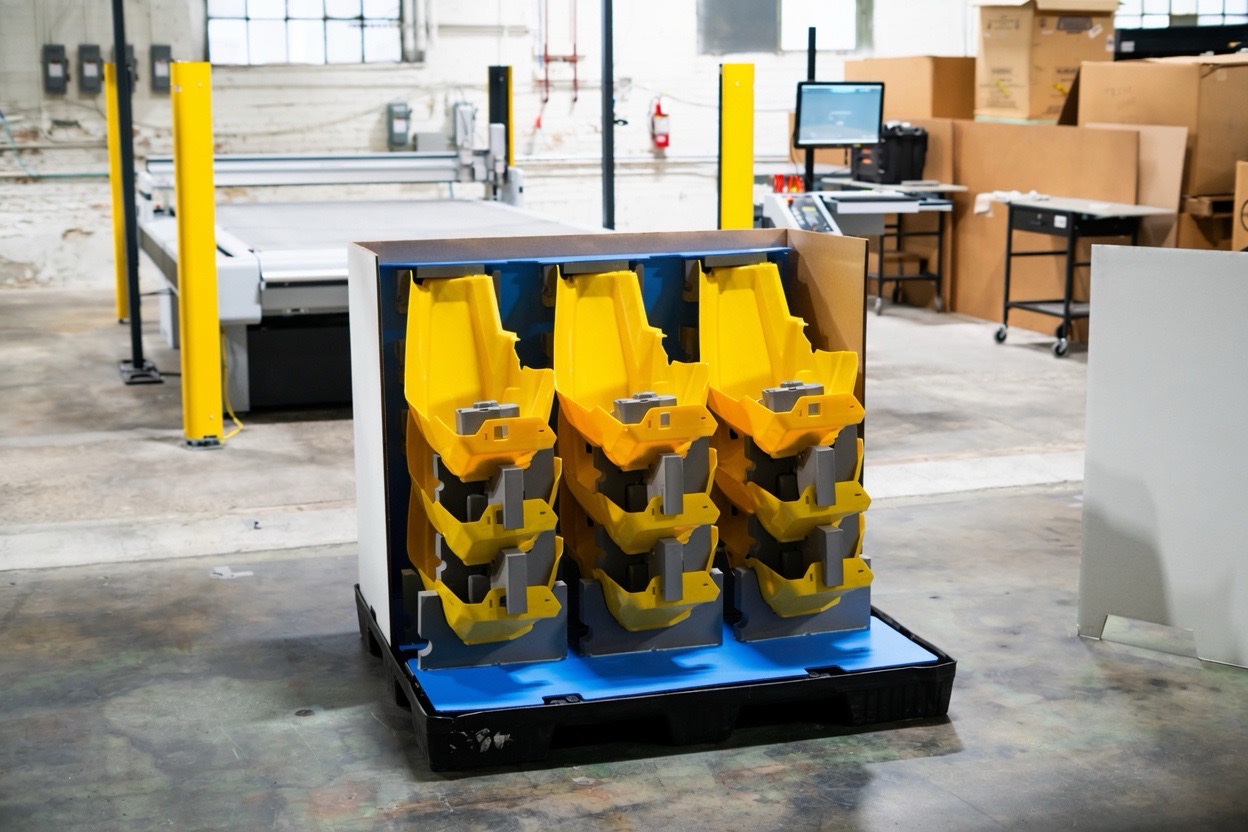
The customer was moving components to its assembly lines in packaging that did not optimize freight and left money on the truck, across an entire product launch. On the main component, the initial direction was to use existing containers, which fit 9 parts per pack and 396 parts per truck. That density was determined by the limited usable interior dimensions of those existing containers, so every shipment carried wasted space. The same issue ran across the program: molded-in-color Class-A hoods and fenders shipped in packs and racks that held fewer parts per truckload than the trailer could carry.
For a high-volume, ongoing program, that gap compounds two ways. First, freight is paid by the trip, so every part that does not fit on a truck raises the cost of moving all the others, shipment after shipment, for the life of the product. Second, at high volume the packaging itself becomes a supply risk. A single high-volume component can require dozens of truckloads of returnable packaging in circulation at once, and if the fleet is sized wrong, the parts supplier runs out of packaging and the assembly line it feeds is exposed. The customer needed more parts per truck and a program engineered so it would never run short.
THE ENGINEERING
The solution
01
Engineering the container to the part
PSi engineered a new container and packaging to the part rather than adapting a stock container. The team developed the container and dunnage from the outset, optimizing the footprint, height, and usable interior dimensions that the customer’s generic containers wasted. On the main component, that raised density from 9 to 15 parts per pack and from 396 to 660 parts per truck. For the hoods, PSi developed an entirely new 57×48 container sized to fit more parts in both footprint and height.
02
Protecting cosmetic surfaces
The molded-in-color fenders carry finished Class-A cosmetic surfaces that cannot arrive scratched or marked. PSi replaced the customer’s existing steel-rack design with a re-engineered pack that protected the finish while fitting half again as many parts per truckload. The density improvement did not come at the cost of part protection.
03
Sizing the fleet to production
Density is only half the program. PSi sized the returnable container fleet to the customer’s production cadence so the supply never broke. That meant working back from the dates that mattered: when the molder began producing a part for a new launch, when parts had to reach the assembly line, and at what daily rate. From a production rate, the fleet is sized so the supplier always has enough packaging in circulation to keep shipping. For a high-volume component, that can mean building on the order of thirty truckloads of packaging to support the program without a gap.
04
Built for the loop
A returnable program only pays back if the containers survive years of cycling out full and returning empty. PSi engineered the packs to hold up across that loop and sized the fleet so the cycle never starves the line. The customer’s supplier runs the fill-and-ship cadence, and the same containers cycle out and back week after week, which is where the returnable economics get earned. PSi’s role is to deliver a returnable system that can take the cycles and the volume without a weak point.
BY THE NUMBERS
The results
Lead component
| Existing containers | PSi engineered pack | |
| Parts per pack | 9 | 15 |
| Parts per truck | 396 | 660 |
- 24% capital cost reduction
- 60% ongoing freight savings
- 60% less material handling
- One of four projects in a launch that reduced capital spend by $247,000
Hoods
| Initial design | PSi new container (57×48) | |
| Parts per pack | 6 | 9 |
| Packs per truck | 44 | 66 |
| Hoods per truck | 264 | 594 |
These containers have since been repurposed across three product redesigns since 2002, still earning their return more than two decades later.
Molded-in-color fenders
| Existing steel racks | PSi engineered pack | |
| Parts per unit | 6 per rack | 9 per pack |
| Parts per truckload | 132 | 198 |
- 33% freight improvement
- 30% capital reduction
Second hood program
| Existing racks | PSi engineered pack | |
| Parts per pack | 10 | 16 |
| Hoods per truckload | 440 | 704 |
- 38% freight improvement
- 60% capital reduction
Why it worked
The gains came from engineering a container to the part that optimized freight rather than accepting the density a stock container happened to offer. More usable interior space per pack means more parts per truck, which lowers freight on every shipment and reduces the number of packs the customer has to buy, store, and handle. Because the packs are returnable and durable, the same investment kept paying back across product generations, and the reduction in trucks lowered trucking, CO2, and overall carbon footprint alongside the cost.
The reason they held up over decades is experience and quality. PSi has engineered packaging for lawn and garden parts for over 30 years, so the team knew how these parts behave before the first design. Returnable packaging is a discipline taught nowhere academically, learned instead on the floor across nearly forty years with this customer and others like it. That is what enables PSi to optimize freight, size the fleet correctly the first time, and engineer packaging a high-volume program can run on for years.
About Us
Packaging Solutions, Inc.
Packaging Solutions, Inc. is a custom packaging engineering company founded in Milwaukee in 1994. For 32 years, PSi has engineered and built returnable packaging systems for manufacturers whose production cannot afford a packaging failure, with engineering and the manufacturing floor under one roof.
Its expertise is both formally credentialed and effectively proprietary:
PSi’s senior packaging engineers hold four-year packaging degrees, while returnable packaging itself is a discipline taught nowhere academically and learned on the floor across decades.