Returnable packaging engineered to deliver a fully assembled, pre-filled brake system ready to install line-side.
Case Study
Taking Bleeding Off the Line: Engineering a Returnable Pack for a Fully Assembled Brake System

Results at a glance
- Removed brake-system bleeding from the assembly line by delivering a fully assembled, pre-filled system ready to install
- A first of its kind: the first time the OEM shipped a fully assembled, pre-filled brake system rather than loose components
- One common primary container scaled across every vehicle platform, with dunnage varied to each part
- High truckload cube efficiency from a 48×48 returnable pallet, double-stacked for full truckloads
THE SITUATION
The challenge
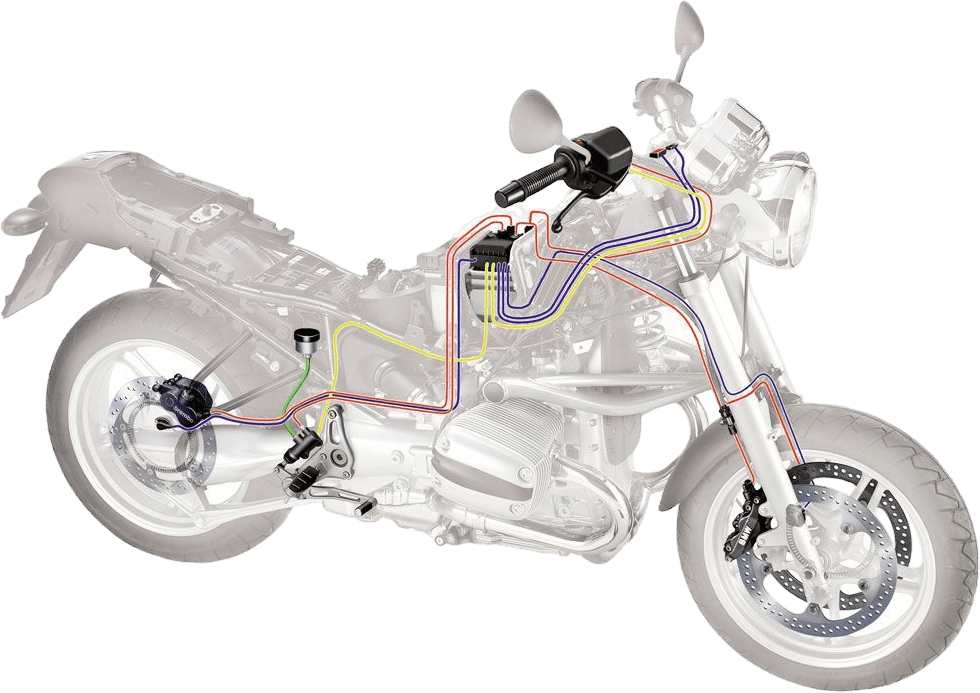
The customer’s brake system arrived at the assembly plant as separate, loose components: the master cylinder, brake lines, calipers, and ABS module, each purchased, shipped, and handled on its own. At the plant, workers installed and bled the brake system on the line. Bleeding is slow, and doing it in line made it a production bottleneck that held back takt time.
The customer wanted to move from loose-component delivery to a fully assembled, pre-filled brake system that could be installed directly onto the vehicle, taking the bleed step off the line entirely. That goal created a packaging problem unlike a normal part. The assembly was cosmetic, and it was filled with brake fluid, which meant it could not be packed on geometry or density alone.
THE ENGINEERING
The solution
01
Getting the non-obvious inputs right
Before any design, PSi had to understand a wide set of inputs, several of which no drawing would show: supply-chain requirements at both the supplier and the OEM, line-side space at each, daily volume and shipment frequency, the vehicle assembly sequence, operator ergonomics, cosmetic surface protection, brake-fluid containment and orientation, the elevation needed inside the pack to keep air out of the system, differences between brake designs across vehicle platforms, the AGV carrier interface, and returnable truckload-cube requirements.
The decisive input was the fluid. A filled brake system had to be oriented and held at specific elevations so that shipment and handling would not introduce air bubbles into the system. That single requirement ruled out packing on geometry or density and drove the entire design.
02
Letting the inputs reshape the plan
The initial goal was one common packaging solution for every vehicle platform. As the part geometry, orientation constraints, elevation requirements, and installation sequence came into focus, it became clear a single solution could not serve every configuration. PSi held a common primary container and varied the dunnage to each platform’s part, rolling out the highest-volume platform first and then extending the same approach across the others.
03
The design
The final solution used a thermoformed primary tray as the shipping container. Inside, a corrugated plastic pad and molded expanded polypropylene (EPP) support assemblies located, elevated, and protected the brake system, chosen for the intricate part shape, the fluid-filled requirement, and the internal cavities. PSi sources molded EPP through a manufacturing partner. A removable thermoformed caddy held the calipers so operators could remove and install them ergonomically during assembly.
The primary tray was engineered to ride on the OEM’s AGV carrier, so the brake system traveled alongside the vehicle during assembly. The trays fit a returnable pallet system on a 48×48 footprint, double-stacked to maximize truck cube, which mattered because the supplier and the assembly plant were in different states. Materials in the solution included polypropylene, high molecular weight polyethylene, XLPE foam, and EPP foam.
The program required close coordination across logistics, purchasing, engineering, safety, packaging, the supplier, and the OEM assembly team.
BY THE NUMBERS
The results
The solution did what it was built to do. A fully assembled, pre-filled brake system arrived ready to install directly onto the vehicle, which removed bleeding from the OEM’s assembly line. Per PSi, the project was justified on the cost savings in takt time and assembly rates that the change delivered. The change reduced takt time by about three minutes per unit.
It was also a first. This was the first time the OEM shipped a fully assembled, pre-filled brake system rather than loose components, and the packaging is what made that delivery model possible. The common primary container scaled across every vehicle platform, and the double-stacked 48×48 returnable pallet gave the program high truckload cube efficiency across a long supplier-to-plant lane.
In the interest of being straight about what is and is not measured here: the OEM tracked downstream metrics such as the exact takt reduction and line-side footprint savings, but did not share those figures with PSi. What PSi can stand behind is the engineering and the delivery model it enabled.
Project timeline: first inputs January 2012, prototype June 2012, production 2013. A first-of-its-kind program runs longer than a routine one, because the inputs themselves have to be discovered.
Why it worked
The program succeeded because the hardest inputs were understood before design, especially the fluid orientation and elevation that no drawing carried, and because the plan was allowed to change when complete inputs showed that one common solution could not serve every platform. This is the principle in practice: the outcome was set at the front of the project, not at the finish.
This project is the real-world example behind our whitepaper on why upfront inputs determine a packaging project’s outcome. Read the whitepaper: How Upfront Inputs Determine the Outcome of a Packaging Project.
About Us
Packaging Solutions, Inc.
Packaging Solutions, Inc. is a custom packaging engineering company founded in Milwaukee in 1994. For 32 years, PSi has engineered and built returnable packaging systems for manufacturers whose production cannot afford a packaging failure, with engineering and the manufacturing floor under one roof.
Its expertise is both formally credentialed and effectively proprietary:
PSi’s senior packaging engineers hold four-year packaging degrees, while returnable packaging itself is a discipline taught nowhere academically and learned on the floor across decades.